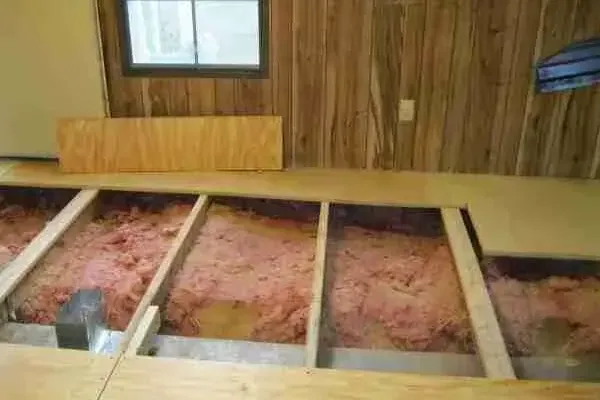
A large share of homes in the valley are manufactured, and their water pipes run through the belly under the floor. A leak down there soaks insulation and decking out of sight, and the first clue inside is often a soft spot in the floor.
Key takeaways
- In a manufactured home, supply and drain pipes run through the belly, the insulated space under the floor.
- A leak in the belly can wet insulation and the underside of the decking long before anything shows inside.
- A soft or spongy floor spot, a sagging belly cover and a musty smell are common clues.
- Wet belly insulation is usually removed, because it holds water against the decking and joists.
- Decking and joists are dried with equipment, and readings decide when the floor counts as dry.
What the belly is, and why it hides leaks
The belly is the bottom layer of a manufactured home: a cover under the joists with insulation packed between them. Supply and drain pipes run through that space.
Wet insulation acts like a sponge. It holds water against the underside of the floor decking, so a small leak can keep a large area wet for a long time.
Nobody sees the belly in daily life, which is why a leak can run for weeks.
Decking that stays wet can soften, and fasteners and framing in contact with it can corrode. The longer the belly stays wet, the larger the repair after the dry-out.
Wet insulation also holds the damp against the floor above, so a small leak keeps working long after the pipe is repaired unless the insulation comes out.
The sooner a leak is found, the more of the original floor can be dried and kept.
Signs of a leak under the floor
The clues are mostly inside, near bathrooms, kitchens and the water heater closet.
No single sign proves a belly leak. A soft spot plus a pump that cycles is a strong pair, and a moisture meter confirms it.
- A soft, spongy or bouncy spot in the floor near a tub, toilet or sink.
- Vinyl or laminate that bubbles, lifts at the seams or stains from below.
- A musty smell in a room with no visible water.
- A sagging or bulging section of belly cover, visible through a skirting vent or access panel.
- A well pump that cycles with nothing running.
Common sources under a manufactured home
Supply pipes and fittings
Mineral-heavy water scales fittings and valves, and a worn fitting can run unseen. See the burst pipe water damage page for how pressurized leaks are handled.
Cold nights
Belly pipes sit outside the heated living space, so clear winter nights can reach them.
A pipe that split in a freeze often shows its leak at the thaw. That case is covered by frozen pipe water damage work, and the belly dry-out is much the same.
Drain pipes and traps
A tub or shower drain that has loosened, or a cracked trap, drips slowly with every use. The leak is small but constant, and it keeps the same patch of insulation wet.
Heater and appliance connections
A water heater closet or a laundry corner can drain through the floor opening and into the belly. A leak there often starts as a damp closet floor.
What gets opened and removed
The crew follows readings, not guesses. The belly cover is opened where moisture points, and the insulation under it is checked.
Access is usually from underneath, so interior flooring stays in place unless readings show it is wet from below.
- Belly cover opened at the wet area, then taped or replaced after the dry-out.
- Soaked belly insulation pulled out and bagged, because it will not dry in place.
- Decking and joists tested with a moisture meter along the length of the leak.
- Soft or delaminating decking marked for repair, since drying cannot restore it.
- Flooring above lifted where it is wet from below.
Drying the decking and joists
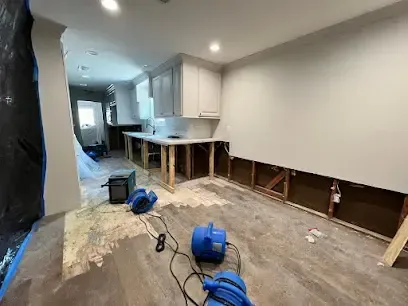
Once the wet insulation is gone, air movers and dehumidifiers dry the framing from underneath. Hoses or ducts carry dry air into the opened belly, and the floor above gets attention as well.
This is structural drying in a tight space, and it ends only when the readings match a dry reference. Standing water inside is handled through water extraction at the start.
The space under a home is tight and often damp, so equipment is placed to move air through the belly rather than around it. Readings are taken from the underside of the decking and from the joists.
- Hoses or ducts carry dry air into the opened belly.
- A dehumidifier runs near the opening to pull moisture out of the air.
- Air movers push air along the decking and joists.
- Readings are logged each day until the framing matches a dry reference.
Stopping the leak and catching the next one early
A plumber repairs the pipe, trap or fitting. Closing the main valve, or the valve past the pressure tank on a private well, stops the water while that repair is set up.
Repairs to the belly cover and the skirting after the dry-out keep rain, cold air and animals out of the space. The full range of this loss type is covered on the manufactured home water damage page, including leaks that start from outside water.
A few quick habits make the next hidden leak less likely to run for long.
- Look under sinks and around the water heater closet for damp or stains.
- Watch whether the well pump runs when no tap is open.
- Press on floor spots near tubs, toilets and the kitchen sink, and note any soft area.
- Use a flashlight at a skirting vent or access panel to look for sagging belly cover.
- Learn where the main shutoff and the pump breaker sit.
Questions
How can a household tell if water is under a manufactured home?
Look for a soft floor spot near a plumbing fixture, a sagging belly cover, a wet smell inside or a well pump that cycles with nothing on. A moisture meter on the floor confirms it.
Does wet belly insulation have to be replaced?
Usually yes. It holds water against the decking and joists, and it does not dry well in place. The decking is dried once the insulation is out. If the insulation is left in place, it keeps the floor above wet.
Can a soaked floor deck be saved?
Often, if it is dried promptly and has not softened or come apart. Decking that has swollen or turned spongy is marked for repair.
Who fixes the pipe, and who dries the floor?
A plumber repairs the pipe, trap or fitting. The restoration team removes the wet insulation, dries the floor structure and logs the readings. Both jobs run together so the floor can be closed up once it is dry and the pipe is sound.
Does the skirting make the dry-out harder?
It limits airflow under the home, so equipment and ducting are set up to move dry air through the opened belly instead of relying on the open space.
How long does drying take after a belly leak?
A contained loss often dries in three to five days. A soaked belly with wet decking and joists can take longer, and the daily readings decide when the equipment comes out.