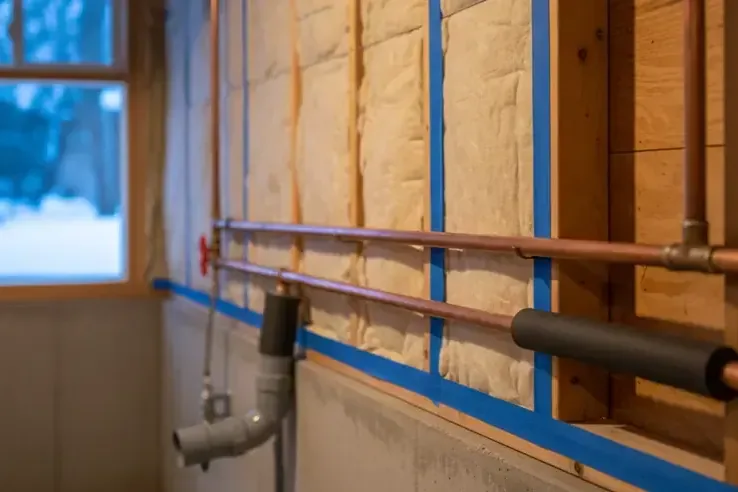
Winter days in the valley can feel mild, but clear nights fall below freezing, and that is enough to split a pipe that was left bare. Most of the protecting happens before the first cold forecast.
Key takeaways
- Clear winter nights in the valley can fall below freezing, and bare or exposed pipes can split on a night like that.
- Hose bibs, pipes in exterior walls and garages, and pipes under manufactured homes are the usual weak spots.
- Find the main shutoff before the cold comes. On a private well, also find the pump breaker and the valve past the pressure tank.
- A split pipe often leaks only when it thaws, so a dry morning does not clear the house.
- Shutting off the water quickly limits the damage if a pipe does split.
Why a mild desert can still freeze pipes
The valley is high desert at about 2,700 feet, below the Spring Mountains. Dry, clear air lets the ground and the house lose heat fast after sunset, so nights can fall below freezing after a pleasant afternoon.
A pipe does not need a long freeze to fail. Ice expands inside the pipe and splits the weakest spot, often a fitting.
The damage stays hidden until the thaw, when the ice melts and water starts to flow through the split.
A freeze that lasts a few hours is enough for a thin pipe or a small fitting. Larger pipes survive longer, which is why the weakest spot, not the whole system, decides the outcome.
The weak spots to check first
Outside the house
Anything that sits outside the heated space freezes first.
- Hose bibs with a hose still attached.
- Exposed supply pipe at the pressure tank, well house or water heater.
- Irrigation supply pipe above ground.
- Pipes along an unheated side of the house.
- Pump or well house plumbing that is not heated.
Inside the structure
Inside, the risk sits where pipes meet cold air.
- Pipes in exterior walls, especially on the shaded side of the house.
- Pipes in garages, laundry nooks and closets with an outside wall.
- Pipes in the attic or in soffits.
- Pipes beside a garage door or a vent that lets in cold air.
Manufactured homes: the belly and the skirting
Pipes in the belly sit under the floor, away from the home's heat. Damaged or missing skirting and open vents let cold air reach them.
A split there wets the belly insulation and the decking before anything shows inside. The manufactured home water damage page shows how that damage is handled.
Mineral-heavy water also scales fittings under the home, so an older fitting can be the first to give way on a cold night.
- Skirting panels that are intact and secured.
- Vent covers closed on freezing nights where the home allows it.
- Pipe insulation and heat tape, if installed, still in place.
- Belly cover with no gaps or sagging near the pipes.
Shutoffs to find before the cold
A household that knows its shutoffs loses less water. Walk through the house, find each valve and turn it once to be sure it is not stuck.
A tag on each valve lets anyone in the house find it in the dark.
- The main water valve for the house.
- The valve at each toilet, sink and washer.
- The supply valve at the water heater.
- The pump breaker for a private well.
- The valve past the pressure tank.
- The supply valve for a swamp cooler.
Simple protection steps
Most of the protecting costs little and takes an afternoon.
The best results come from doing these steps before the first cold forecast and again whenever a hard freeze is expected.
None of this replaces a plumber for a pipe that has already failed, but it makes a failure far less likely.
- Disconnect and drain garden hoses, then cover each hose bib.
- Wrap exposed pipes with foam insulation.
- Close garage doors and seal gaps near pipes.
- Open cabinet doors on exterior walls on a freezing night.
- Keep the heat on if the house will be empty.
- Drain or cover a swamp cooler supply pipe.
- Seal gaps where pipes pass through an exterior wall.
- Insulate the exposed pipes at a pressure tank or well house.
What a split pipe does to a house
A pipe that splits inside an exterior wall waters the cavity as soon as the ice melts. The water soaks insulation, runs down the framing and spreads across the floor at the bottom of the wall.
In a slab house, that floor is concrete topped with flooring, so the water sneaks under tile and wood. In a manufactured home, it drains toward the belly.
The longer the water runs, the more of the wall and floor it reaches, which is why finding the main valve in advance matters.
A split in an attic or soffit pipe drips onto the ceiling below, so a stain on a ceiling after a cold night is a clue worth following.
- Wall cavities hold water that no one can see.
- Ceilings below an attic or a soffit pipe stain and sag.
- Flooring near an exterior wall cups or lifts.
- Cabinets on an outside wall swell at the base.
If a pipe splits
Speed matters more than anything else once a pipe fails. The frozen pipe water damage page covers the whole process, and pressurized failures follow the burst pipe water damage steps.
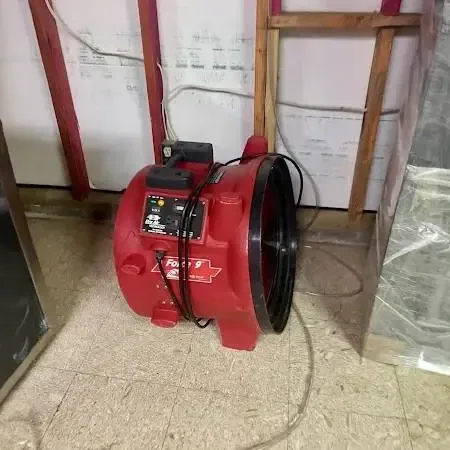
After the water is stopped, water extraction removes what is standing and drying follows the readings.
A pipe that split overnight may look fine until the water flows again. Check walls, ceilings and the floor below after the thaw.
- Close the main valve, and switch off the pump breaker on a private well.
- Keep clear of wet outlets and cords.
- Photograph the split, the wet rooms and any damaged belongings.
- Call for extraction, and a plumber for the pipe.
Questions
How cold does it need to get for pipes to freeze?
Pipes are at risk when the air stays below freezing for several hours, and bare or exposed pipes go first. A clear night is more dangerous than a cloudy one. A short, hard freeze can do as much harm as a long, mild one.
Should a faucet drip on freezing nights?
Insulating and sealing the weak spots works better than leaving a tap running. A running tap makes a private well pump work and adds water to a septic system.
How can a household tell a pipe split overnight?
Low pressure, no water at a tap, a damp patch on a wall or ceiling, or the sound of running water after the thaw are the usual signs. A bubble in the paint or a soft spot in the drywall is another clue.
Do manufactured homes freeze differently?
Yes. The pipes run through the belly, outside the heated living space, so skirting and vents matter, and a leak can run unseen under the floor. Skirting and vent covers are the first checks.
Should the water be shut off when leaving on a trip?
Closing the main valve limits the damage if a pipe fails while the house is empty. A private well household can also switch off the pump breaker. An empty house is also where a failure goes unnoticed the longest.
Who repairs a split pipe, and who dries the house?
A plumber repairs or replaces the split section. The restoration team extracts the water, opens wet cavities where readings call for it and dries the structure.