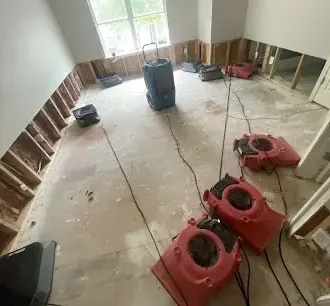
The valley is arid, so it is easy to assume a wet house will dry itself. Surfaces do dry fast, but the water that causes the damage sits under tile, inside wall bottoms and beneath floors.
Key takeaways
- Low humidity dries surfaces, not water trapped under flooring, behind baseboards or inside walls.
- Materials left to dry alone stay damp for days, and damp drywall and framing can start growing mold in the first day or two.
- Real drying starts with extraction, then adds air movement and dehumidification.
- Equipment is sized to the class of loss, and readings against a dry reference decide when it comes out.
- A surface that feels dry is not proof. A moisture meter is.
Surface dry is not structure dry
Dry air pulls moisture off any surface it can touch. A wet towel on a patio dries fast, and so does the top of a wet carpet.
Water in a wall, under a floor or in a slab has no airflow to carry it away. It moves slowly toward the surface, or it stays where it is.
The valley sits at about 2,700 feet and is arid, but a house is a closed space. What the outside air does at the door says little about what is happening inside a wall.
Outside air is not always dry, either. Monsoon months bring humid, stormy air, and a wet house in July does not dry on its own the way it might on a winter afternoon.
Where water hides in a dry climate
Water settles in a few places that a towel or a fan cannot reach, which is why hidden water sets the length of the job.
Under tile and flooring
Tile and sheet flooring seal the surface, so water that gets under them stays under them. Wood and laminate trap it between the planks and the concrete.
- Grout and seams that look dry while the pad or slab beneath is wet.
- Planks that cup or buckle as the water works its way up.
Inside wall bottoms
Drywall wicks water upward from a wet floor. The paint can look normal while the lower part of the wall is soaked, and the framing behind it stays wet.
- Baseboards and wall plates that stay stained.
- Insulation inside the wall that holds water against the drywall.
In the slab and its edges
Concrete holds water and gives it up slowly. The edges of the slab and the plates that sit on it stay wet long after the surface looks fine.
Under manufactured home floors
Belly insulation holds water against the decking for a long time. The manufactured home water damage page shows how that kind of loss is dried.
What drying actually involves
Drying is a sequence, and each step does something that open air cannot. The work starts with water extraction and moves on to equipment.
The class of loss describes how much water the materials hold and how fast it can leave. Class 1 is the lightest, and Class 4 covers dense materials such as concrete and hardwood that hold water deep inside.
- Extraction pulls standing water and water held in carpet and pad.
- Materials that will not dry in place, such as soaked pad and insulation, are removed.
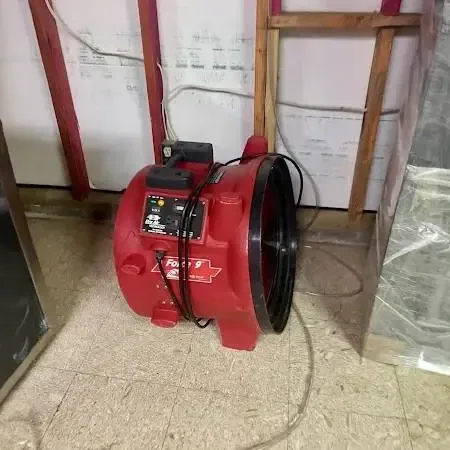
- Air movers push air across surfaces and into wall bottoms.
- Dehumidifiers pull moisture out of the air so materials can give up their water.
- Wall bottoms and cavities are opened where readings show trapped water.
- Moisture readings are taken each day and logged.
Why a box fan and open doors fall short
A household fan feels like progress, but it only moves air. It cannot pull water out of drywall, framing or the layer under a floor.
The right equipment is chosen for the class of loss and the size of the room, not for how loud it is. A few well placed air movers with a dehumidifier do more than many fans.
- A box fan does not reach water inside a wall or under flooring.
- Open doors can let in humid air after a monsoon storm.
- Fans can spread dust and contamination when the water was dirty.
How a dry reference ends the job
A dry reference is a reading taken from the same material in a part of the house the water never touched. A wet material counts as dry when its reading is only 2 to 4 points above that reference.
The drying time estimator gives a rough idea of how long a loss might take. The daily readings decide when the equipment actually leaves.
Readings come from a moisture meter on drywall, wood and concrete, plus a meter for air temperature and humidity. The same spots are measured every day, so progress is easy to see.
Signs a house is still wet after it feels dry
A room can feel fine to the hand while the structure is still holding water. These clues say otherwise.
Any one of these is a reason to take a moisture reading before the house is closed up.
- A musty or earthy smell in a closed room.
- Wall bottoms that feel cool or clammy to the touch.
- Paint that bubbles or peels near the floor.
- Wood or laminate that keeps cupping after the surface dried.
- Baseboards that stay stained or swollen.
- A room that stays humid when the rest of the house is dry.
How long drying takes
A contained Class 1 loss usually dries in three to five days. A slab leak or a wet floor over a belly takes longer, since water keeps feeding the wall bottoms.
See the structural drying page for how equipment is sized and how readings are logged.
Equipment is checked every day, and it is moved as areas reach dry. The crew also keeps the readings so anyone can see how the house reached dry.
Questions
Does desert air really not dry a wet house?
It dries surfaces quickly, but it does not reach water under tile, inside walls or beneath floors. Those spots stay wet without extraction and equipment. Water stays in those places for days.
Is it enough to open windows after a leak?
No. Open windows move air through the room, but they do not pull water out of wall bottoms or flooring layers, and they can let in humid air after a storm. A fan can help the final stage of a small, clean spill, but a real leak needs equipment sized to the loss.
How can a household tell whether a wall is really dry?
A moisture meter reading compared with a dry reference from the same material is the test. Touch and sight cannot tell. The crew marks the test points on the walls and floors, so the same spots are checked every day.
Why does dehumidification matter in a desert?
A wet structure raises humidity in a closed room, and dehumidifiers pull that moisture out of the air so the materials keep releasing water. That cycle is what dries a structure.
How long can wet drywall sit before it causes a problem?
Damp drywall and framing can start growing mold in the first day or two, so starting extraction early keeps more of the house dryable.
Does dry weather shorten the drying time?
Dry outdoor air can help a closed house stay dry once the structure has been dried, but it does not replace extraction, removal and equipment inside the house.